
Clearwater neighborhood · 33767
Tree Trimming in Island Estates, Clearwater, FL
Island Estates sits on about 210 acres of filled land off Memorial Causeway, with one road on and off. Helene's surge put salt water across much of it in September 2024, and the palms and yard trees are still showing what that did.
- ZIP
- 33767
- Jurisdiction
- City of Clearwater
- Way in or out
- Memorial Causeway only
- Land filled
- 1950s–60s
Local snapshot Island Estates
- Area
- About 210 acres, per the city's neighborhood plan
- Land created
- Filled in the 1950s and 1960s; platted 1957–1969
- Road access
- Memorial Causeway is the only way in or out
- Civic association
- Organized in 1962
- Properties in the overlay district
- 625
- Population, 2000 Census
- 3,201, as reported in the city plan
- Helene at the nearby Clearwater Beach tide gauge
- 6.67 ft, the highest on record there (Sept. 26, 2024)
Landmarks & streets Near our work
- Clearwater Marine Aquarium249 Windward Passage, the island's best-known address.
- Sunset Sam Park205 Windward Passage, named for a dolphin the aquarium rescued in 1984.
- Memorial CausewayThe only route on or off the island, linking it to downtown and the beach.
- Island WayThe main road off the causeway that every street on the island branches from.
- St. Brendan's ChurchOn Dory Passage, one of the places named in the city's neighborhood plan.
- Island Yacht ClubAnother fixture the city plan lists among the island's places.
Island Estates Tree Trimming Two Years After the Surge
Bay News 9 called Island Estates one of the hardest-hit parts of Clearwater in Hurricane Helene, and one resident described water climbing from the street to the tops of the mailboxes. Two years later the streets show every stage of recovery at once: houses repaired, houses gutted, houses under construction and lots scraped down to sand. The trees are just as mixed. Some palms that looked fine in October 2024 browned out the following summer, while others that looked finished pushed out new spears.
That is the difference between salt and wind. Milton arrived two weeks after Helene with gusts near 90 mph at the Clearwater Beach station and snapped limbs that were obvious the next morning. Helene's harm here was mostly water. According to Pinellas County Extension, a soaking in seawater can desiccate nearly every kind of tree and shrub in two to three days, and the chloride left behind gets stronger as the flooded ground dries out, until enough rain leaches it away. A tree can sit in that soil for months before the crown admits anything is wrong.
Palm Tree Trimming or Removal: Sorting Salt-Damaged Trees
Most Island Estates calls now come down to one question: is this tree coming back? We answer it tree by tree, on site, and sort what we find into three groups.
Trim and keep
- Sabal palms with a green spear and new fronds, even if older fronds are brown. On the Pinellas Extension list, no tree beats the sabal for handling salt or standing up to wind.
- Live oaks, buttonwoods and sea grapes that have pushed fresh leaves on live twigs.
- Trees whose damage came from salt spray on the leaves rather than seawater standing over the roots.
Wait a season
- Palms with a firm bud but few fronds. Extension advice is that a recovering palm may need six-plus months to push out fresh fronds, and one to two years before the crown looks full again.
- Broadleaf trees that dropped their leaves but still have green, flexible wood under the bark.
- Anything we can't call with confidence. A second look in spring costs far less than losing a tree that would have recovered.
Remove now
- Palms with a collapsed or rotting bud, or a spear that pulls straight out.
- Trees with a heaved root plate, a split trunk, or a lean toward a house or seawall.
- Declining queen palms. Queens sit in Category II of the state invasive species council's list, so replacing one with a sabal is rarely a hard call.
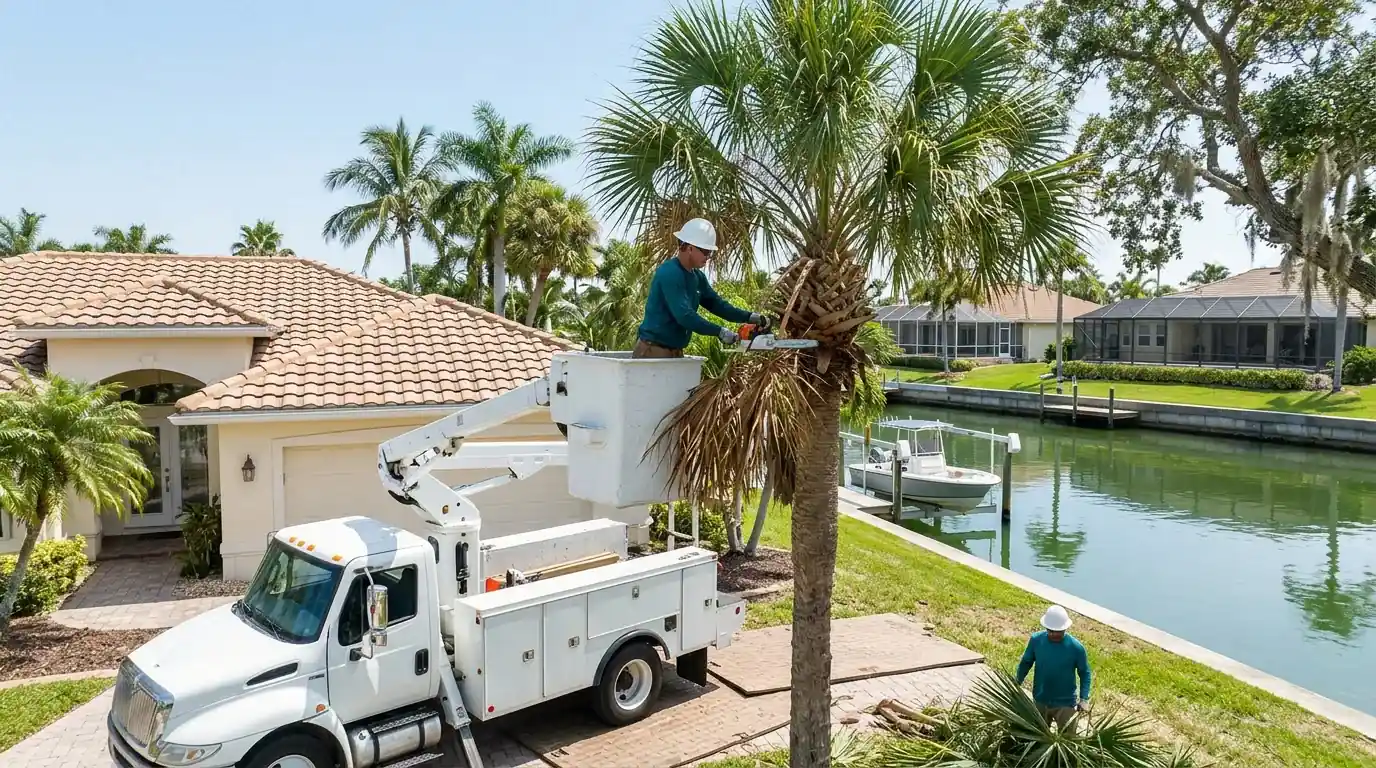
Wait-and-see trees still get a light trim, because dead fronds, seed pods and broken limbs are what fly in the next storm. Green fronds stay on. Our palm tree trimming page explains why, and the article Does Salt Water Kill Trees? goes further into what Helene's water did to island yards.
Tree Service Around Island Estates Rebuilds
Rebuilding changes the tree question. A house being raised, a new foundation, or a lot cleared to bare fill puts trees in the path of equipment, and trenching cuts roots. A tree that came through the surge can still fail a year later from roots severed on one side. Before construction starts, it pays to have the keepers pruned for clearance, so nobody does it with an excavator bucket, and to have the others taken out properly.
The whole island is inside City of Clearwater limits. Taking out a protected tree, or a palm whose straight, clear trunk has reached 10 feet, calls for a city permit; $15 covers the first five trees or fewer and every tree beyond that adds $3. The code excludes hazardous trees such as dead or storm-broken ones from protection, but city staff decide that status, so we file the paperwork rather than assume. Trimming has its own ceiling: a protected tree may give up no more than three-tenths of its leaves in a year, and topping is banned. For a detached house used as one family's home, the state tree statute, 163.045, replaces that permit when a certified arborist (ISA) or Florida-licensed landscape architect inspects the tree in person and signs a risk assessment. We can help set that up.
Seawalls, Mangroves and Shoreline Tree Trimming on Island Estates
Nearly every lot here backs onto a canal or Clearwater Harbor. We don't set equipment on a seawall cap, and cut wood never goes into the water; pieces are lowered to the yard side and carried out. Trees whose roots are pressing against a seawall get a closer look before we recommend anything, since the right answer depends on the wall as much as the tree.
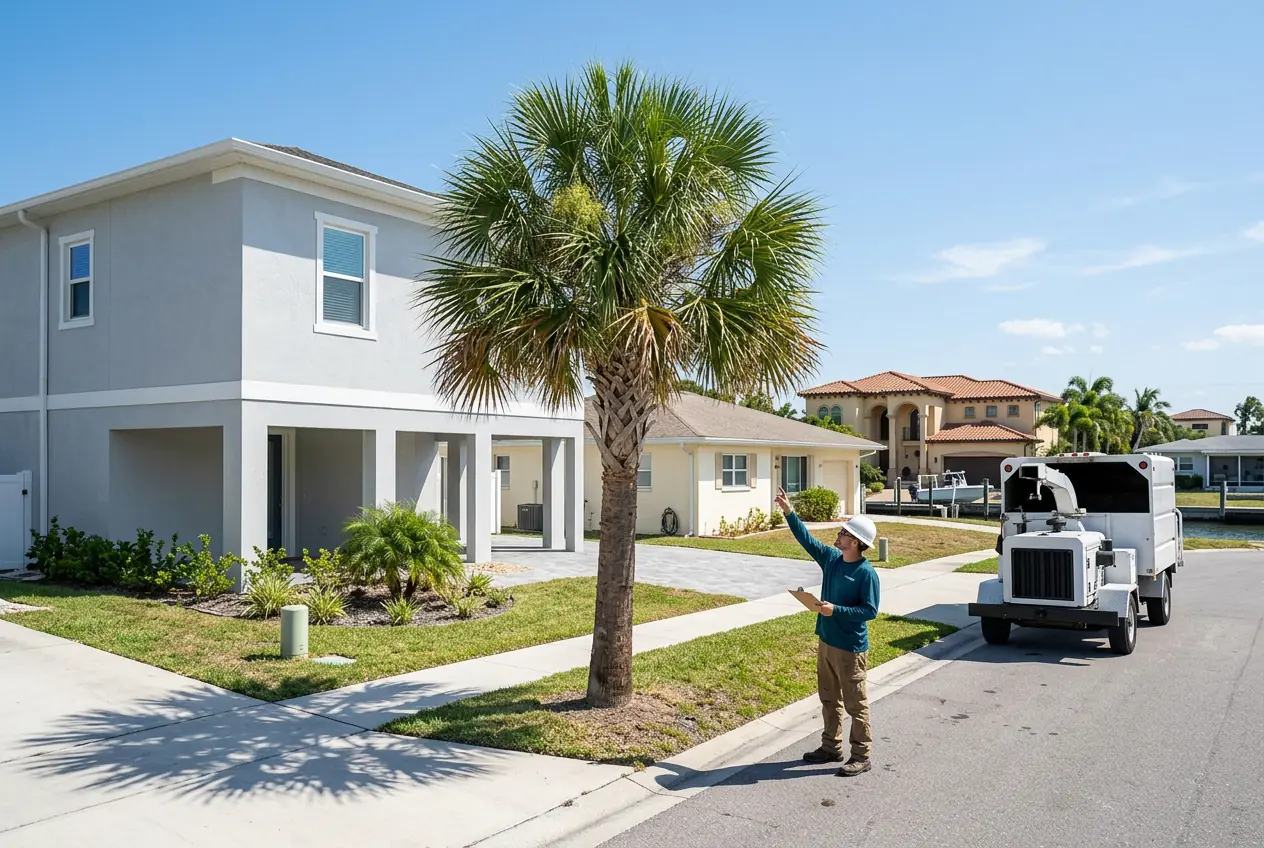
Mangroves along a shoreline fall under Pinellas County's mangrove code and state law, not the city tree permit. Owners can cut back mangroves up to 10 feet tall as long as they stay at least 6 feet high; anything taller is work for a professional trimmer on the county's registry, and the permitted season opens March 1 and closes November 30. We never take mangroves out, and we can show you where the county publishes its list of registered trimmers. Our Pinellas mangrove trimming rules guide has the details.
Getting a Tree Crew On and Off Island Estates
With one causeway in and residential streets crowded with contractor trailers and dumpsters on many blocks, the plan for a visit matters as much as the cutting. Here is how a typical job runs:
- We time the trip to avoid the heaviest beach traffic on the causeway where we can.
- We park the truck and chipper so a neighbor's driveway and a builder's delivery can both get past.
- Brush is chipped on site and hauled off the island the same day. City rules put contractor debris on the contractor, so your curb stays clear.
- Where a tree crowds the overhead wire running to the house, we first ask Duke Energy to cut power to that line, which Duke says costs the owner nothing.
Tight canal lots sometimes leave no path for a bucket truck to reach the back yard. Those trees are climbed and rigged without spikes on any palm we're keeping, or, for a large tree over a new roof, lifted out by crane when the job calls for one.
Island Estates Tree Trimming Costs
Most island work is palms, so most prices are per palm. Around Clearwater in 2026, a palm between 15 and 30 feet usually costs $125–$325 to trim, and one under 30 feet costs $200–$550 to take down, depending on whether it can fall in one piece or has to come apart over a pool or dock. Several palms on one trip bring the price per palm down. None of this is a quote; we hand you a firm price in writing at the house, haul-off and cleanup included, permit fees at cost.
| Job | Typical range | What moves the price |
|---|---|---|
| Short canal-yard palm (under 15 ft), trimmed | $75–$175 apiece | How many palms, pods hanging |
| Salt-browned palm, 15–30 ft, cleaned up | $125–$325 apiece | Dead frond volume, reach from the yard |
| Dead palm under 30 ft, taken down | $200–$550 apiece | Whole drop or cut in sections near the dock |
| Dead palm 30–60 ft, taken down | $450–$1,100 apiece | Truck access on a tight lot, what's underneath |
| Grinding the first stump | $150–$375 ($110 minimum visit) | Stump width and how close it sits to the seawall |
Just across the causeway, Clearwater Beach takes the Gulf head-on, and the mainland end of the bridge lands in downtown Clearwater. For the rest of the city, start with our Clearwater tree service overview, or request a free estimate for your canal lot.
Island Estates Tree and Palm Questions
Not necessarily. If the spear in the center is green and firm and new fronds are coming, the palm is recovering, and Extension guidance says that can take six months or more. If the bud is collapsed or the spear pulls out, it's dead. We check each palm before recommending removal.
Possibly. Island Estates is in the City of Clearwater, where any palm whose trunk runs clear and straight for 10 feet can't come out without one. Dead and storm-damaged trees can fall under the code's hazardous-tree exclusion, but the city makes that call, so we handle the paperwork instead of guessing.
Pinellas County's mangrove code governs them. You may trim mangroves yourself if they are 10 feet or shorter and you leave them 6 feet tall or more. Taller stands go to a trimmer on the county registry, within the March-to-November season. We don't remove mangroves, and we'll help you find a registered trimmer. Our Pinellas mangrove trimming rules guide has the details.
Yes. We chip on site and drive every load off the island that day. In Clearwater the company that makes the debris has to take it, so nothing sits on your curb.
Before the builder starts. Trees that will stay should be pruned for clearance and have their root zones kept clear of trenching; trees in the footprint should be removed under a permit first. It's cheaper and safer than working around equipment later.
Clearwater's, for trees and palms on land. The county's mangrove code applies to mangroves along the shoreline.
Near Island Estates
Close by, same crew.
Tree Services in Island Estates
Booked on the same visit.
Trimming
- Tree TrimmingRoof, pool-cage and driveway clearance, deadwood and crown thinning.
- Palm Tree TrimmingDead fronds, pods and fruit stalks off; green fronds stay.
- Oak Tree TrimmingLive, laurel and water oaks pruned within city canopy limits.
- Hurricane PruningPre-season crown cleaning and thinning, booked before June.
- Tree Trimming Near Power LinesService-drop clearance, scheduled around a Duke disconnect.
Removal
Get a Fixed Price for Your Island Estates Trees
Tree work in Island Estates? We’ll come look.
One visit, one written price, cleanup included. Mon–Sat 7am–6pm.
Mon–Sat 7am–6pm · storm calls taken