
Clearwater · Pinellas County, FL
Residential Tree Trimming in Clearwater, FL
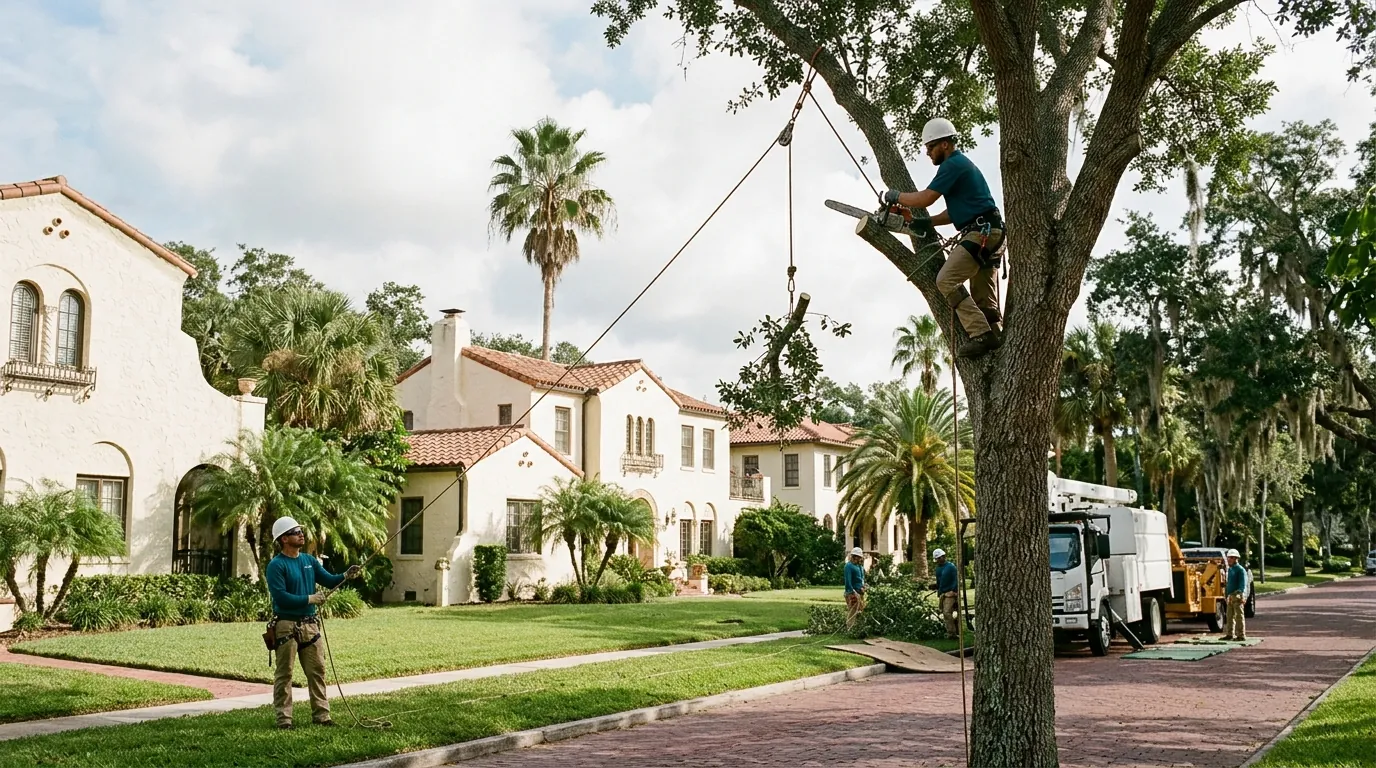
A good trim in Clearwater is mostly about restraint. The city lets no more than 30% of a protected tree's foliage come off in a year and treats topping as illegal, and its neighbors draw the line even tighter. We cut for clearance, deadwood and wind, inside the limit that applies to your address, then rake up and haul away every branch.
- Typical range
- $125–$2,000 per tree
- Clearwater limit
- 30% of foliage a year, no topping
- Estimate
- Free, on site, written
- Included
- Cleanup and haul-off
Residential Tree Trimming in Clearwater Starts With Whose Rules Apply
Two houses with the same Clearwater mailing address can fall under two different tree codes. One may sit inside City of Clearwater limits; the other may be in unincorporated Pinellas County, the way much of Feather Sound is. A few streets north you are in Dunedin, a few east you are in Safety Harbor, and each of those cities writes its own pruning limit. So before we price any job we look the parcel up on the Pinellas Property Appraiser site, which is the same check the city itself tells residents to make. That one step is the difference between an honest trim and a crew that accidentally commits an illegal removal on your behalf.
Here is how the limits line up across the north county, as written in each code we read:
| Where the tree stands | How much can come off | Other trimming rules |
|---|---|---|
| City of Clearwater | No more than 30% of a protected tree's foliage in one year | Topping illegal; flush and stub cuts improper; spikes banned on protected trees |
| Dunedin | Up to a quarter of the leaf canopy; past that, a permit | Grand Trees need a permit even to prune; lion's-tailing named as illegal |
| Safety Harbor | No more than 25% of the canopy per year (dead limbs excepted) | Topping banned; ANSI A300 required; hired crews follow ANSI Z133 |
| Largo | 25% crown standard exists but excludes homes | Owners keep 8 ft over sidewalks and 16 ft over roads |
| Unincorporated Pinellas | No yearly percentage found in the 2026 code | Removal and “effective removal” are what the code regulates |
Clearwater's code goes one step further than most homeowners expect: pruning that kills a protected tree counts as removing it, and over-pruning is handled as an illegal removal. The post on Clearwater's legal trimming limits walks through every number, and the removal side lives in our north Pinellas permit comparison.
Clearwater Tree Trimming Jobs, From the Roof Down
Most calls fall into a handful of problems. Each one gets a different cut, and on a big job we often handle three or four of them in a single visit.
Limbs over the roof
Branches that sit on shingles or tile scrub the surface in every breeze and give rats a ramp to the attic. We shorten those limbs back to a side branch big enough to take over, which keeps the tree's natural outline and closes cleanly, instead of lopping everything at one length. On the 1920s houses in Harbor Oaks the pieces come down on ropes so nothing lands on a clay-tile roof or a detached garage.
Pool cages and lanais
Screened enclosures are everywhere in neighborhoods like Countryside, and they do not survive a falling limb. Clearance over a cage is about the next five years of growth as much as today, so we cut back far enough to buy time without stripping the side of the tree. Our crew never climbs on the cage frame.
Driveways, walks and the street
Raising a crown takes out or shortens the lowest limbs to give cars, mowers and people headroom. We spread a big raise over two visits when the tree needs it, because one heavy session leaves a tall pole with all its weight at the top.
Deadwood and crossing limbs
Dead branches are the pieces most likely to break off in a summer squall. Taking them out removes weight without touching the live canopy, and Safety Harbor's code says outright that dead limbs do not count against its 25% cap. Crossing limbs that rub through each other's bark come out at the same time.
Tree Pruning Clearwater Codes Treat as Damage
Some of the cheapest trims on the market are also the ones the codes describe as harm. We turn those jobs down, and we tell you why:
- Topping. Clearwater defines it as cutting between nodes to take out the vertical leader stems, and makes it unlawful. If a tree truly seems to need topping, say under wires, the city requires a removal permit first. At that point removal is usually the honest answer.
- Flush and stub cuts. A cut tight against the trunk takes out the collar that seals the wound; a stub left mid-limb rots back. Both are listed as improper in the Clearwater code. We cut just outside the collar.
- Climbing spikes on a tree we are keeping. Each spike punches a wound through the bark. Clearwater bans spikes on protected trees; we use ropes, saddles or a bucket truck instead.
- Lion's-tailing. Stripping the interior and leaving tufts at the ends piles the weight at the tips, which is the opposite of what you want in a gust. Dunedin names it as illegal.

We prune to the ANSI A300 standard on every job. That is our practice, not something Clearwater's code names, though Safety Harbor writes A300 straight into its rules.
Trimming Trees in Clearwater on the Right Calendar
Storm season on the Atlantic side lasts from June 1 to November 30, and the best trimming window around here is late winter into spring, before it opens. The City of Clearwater adds its own reason in the city's storm-prep advice: when a storm with a name is headed this way, put the saw down, since a fresh brush pile at the curb is a pile of future missiles. A September trim also leaves no time for new growth to fill in before the windiest weeks. Dead, broken or hanging limbs are the exception; those can come off any time of year. For the full pre-season plan, see hurricane pruning.
Coastal lots add one more wrinkle. On Island Estates and the beach, salt spray burns the windward side of a canopy, and trees that sat in Helene's surge can take a full growing season to show what survived. We would rather wait for new leaves than cut out wood that turns out to be alive.
Tree Trimming Cost in Clearwater, FL
Plan around these 2026 ranges for the Clearwater area; they are not quotes: we walk the property, then put one fixed price in writing before anything is cut, and that price covers cleanup and haul-off.
| Job | Typical range | What moves the price |
|---|---|---|
| Tree trimming, small (under 20 ft) | $125–$350 per tree | access, debris volume, several trees in one visit |
| Tree trimming, medium (20–40 ft) | $300–$750 per tree | climb vs bucket truck, roof and line clearance, number of cuts |
| Tree trimming, large (40–60 ft) | $650–$1,400 per tree | canopy spread, rigging over roofs and pools, deadwood load |
| Tree trimming, 60 ft+ or over a structure | $1,100–$2,000 per tree | bucket reach or crane, crew size, haul-off |
| Crown thinning / hurricane pruning | $350–$1,300 per tree | tree size, deadwood, how much canopy (legal caps apply) |
Several trees on one visit usually lower the per-tree number because the crew sets up once. Palms are priced per palm by height on our palm tree trimming page, and big live and laurel oaks have their own bands under oak tree trimming. Normal pruning rarely needs a permit; if your job does, the city fee is itemized at cost.
Wires change the plan entirely. If limbs touch the cable feeding your meter, read tree trimming near power lines before anyone climbs. For everything else, our Clearwater tree service starts with a free look and a written price; ask for yours here.
- Tree Permits in North Pinellas: Clearwater, Dunedin, Safety Harbor, Belleair, Largo and the County Compared (2026)
- How Much Can You Legally Trim a Tree in Clearwater? The 30% Rule, the Topping Ban and What Dunedin and Safety Harbor Allow
- What Tree Trimming Costs in Clearwater in 2026: Prices for Trees, Palms and Oaks
Tree Trimming Clearwater Questions
Inside City of Clearwater limits, no more than 30% of a protected tree's foliage may come off in one year, and topping is unlawful. Dunedin and Safety Harbor set the cap at 25%. Unincorporated Pinellas regulates removal rather than a yearly percentage. We confirm which code covers your parcel before we quote.
Ordinary pruning within the 30% limit does not need one. The city requires a removal permit before any topping, even near wires, and treats over-pruning as an illegal removal. Dunedin's Grand Trees need a permit even to prune. Rules change at the city line, so we check the address first.
Typical 2026 Clearwater-area ranges run $125–$350 for trees under 20 feet, $300–$750 for 20–40 feet, $650–$1,400 for 40–60 feet and $1,100–$2,000 for taller trees or trees over a structure. Cleanup and haul-off are included. Each tree gets its own written number, free, once we have walked the yard.
Aim for the months between New Year's and Memorial Day, ahead of the June 1 start of the season. Clearwater's storm guidance also tells residents to stop trimming when a storm has been named, because loose cuttings can be thrown by the wind. Dead or broken limbs can come off any time.
No. Topping is illegal on protected trees in Clearwater and banned in Safety Harbor, and it produces weak regrowth that is back on the roof within a few years. We shorten limbs to healthy side branches, or tell you plainly when a tree has outgrown its spot.
No. City rules make contractors take their own brush away, and every price we write includes cleanup and haul-off, so your yard-waste allowance stays free for your own clippings.
More Clearwater Tree Services
Booked on the same visit.
Trimming
- Palm Tree TrimmingDead fronds, pods and fruit stalks off; green fronds stay.
- Oak Tree TrimmingLive, laurel and water oaks pruned within city canopy limits.
- Hurricane PruningPre-season crown cleaning and thinning, booked before June.
- Tree Trimming Near Power LinesService-drop clearance, scheduled around a Duke disconnect.
Removal
Book a Trim Before Storm Season
Tree getting too close to the roof? Let’s look at it.
Clear roofs, legal cuts and a yard left clean.
Mon–Sat 7am–6pm · storm calls taken