
Clearwater · Pinellas County, FL
Palm Tree Trimming in Clearwater, FL
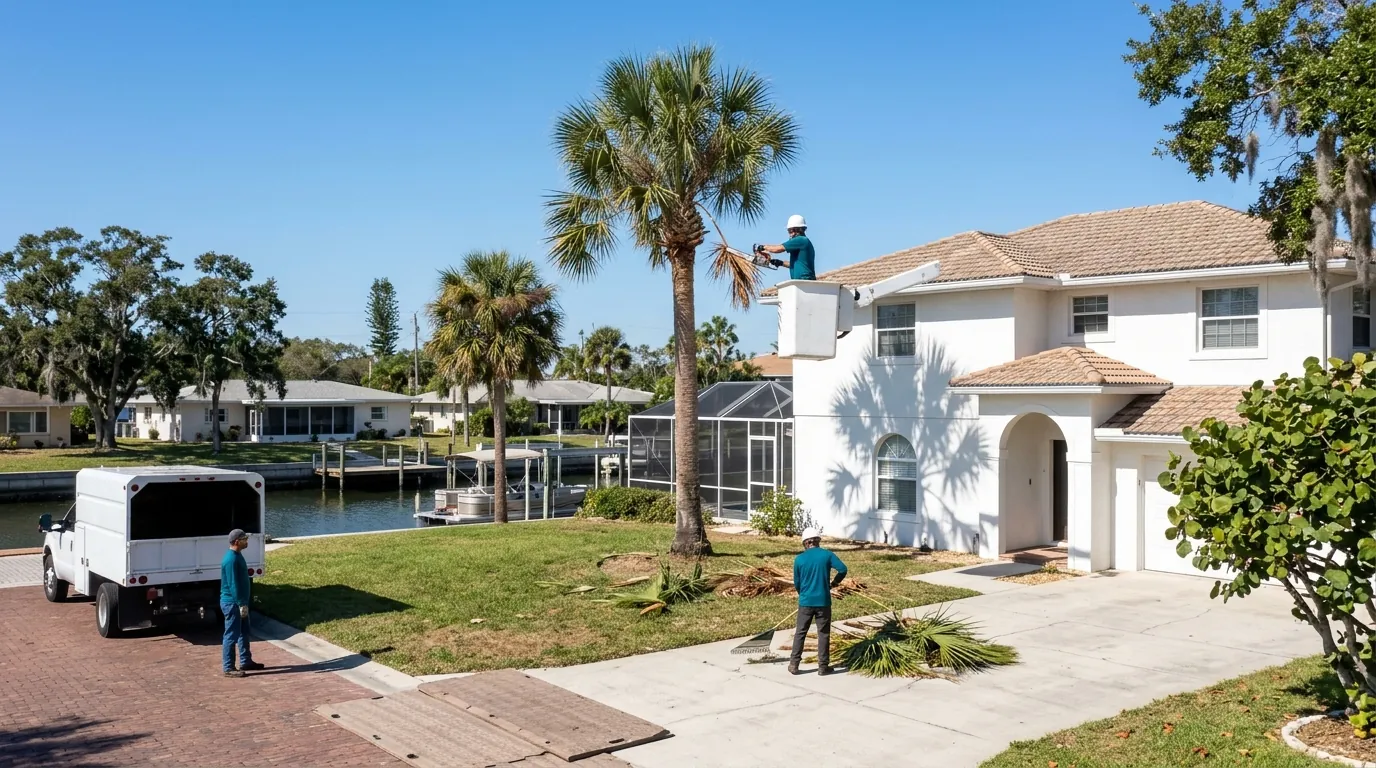
Palms carry most of the Clearwater skyline, from the sabals along beach streets to the Washingtonias that tower over Island Estates canals. Trimming them well means taking off less than people expect: fully dead fronds, seed pods and fruit stalks, with the green crown left whole and a clean saw on every palm.
- Typical range
- $75–$900 per palm
- Green fronds
- Stay on the palm
- Every palm
- Fresh or sanitized saw
- Included
- Fronds and pods hauled off
Palm Tree Trimming in Clearwater Is a Short List of Cuts
A palm has one growing point, the bud crowning its trunk, and every frond it holds is either feeding that bud or finished. The whole job comes down to telling the two apart. Here is what we take off and what we leave, on every species:
- Off: completely brown, dry fronds, flower and fruit stalks, seed pods, loose boots that are already pulling away, and anything hanging over a walkway, pool or car.
- On: every green frond, and the yellowing older fronds too. A palm pulls potassium out of those lower fronds to feed new growth, so cutting them early starves the crown in the sandy soils we have here.
- Never: anything above horizontal. Picture the crown as a clock face; nothing growing above 9 and 3 comes off. UF/IFAS Extension treats that line as an absolute limit. It is a floor, not a target, and most healthy palms need far less taken off than that.
That last point is where most bad palm work starts. A “hurricane cut” leaves a palm with a skinny tuft of fronds pointing at 11 and 1 o'clock, and it gets sold as storm prep. The research points the other way: across the 2004 and 2005 seasons, palms trimmed like that lost their crowns to snapping more often. Our post on hurricane cuts lays out the evidence, and hurricane pruning covers what actually helps before a storm.
Clearwater Palm Trimming by Species
The palms around Clearwater do not all ask for the same visit. Height sets the price, but the species sets what we look for once we are up there.
Sabal (cabbage) palm
Florida's state tree is also the toughest palm on the Pinellas Extension list, given its top marks in salt tolerance and in wind resistance during hurricanes. Sabals drop much of their own litter, so a trim is often just flower stalks and a ring of dead fronds. They are also the main local host of lethal bronzing, which is why we look hard at the color of the lowest fronds on every sabal we climb.
Queen palm
Queens are planted everywhere and drop heavy fruit clusters that stain pavers and pool decks, so stalk removal is most of the work. Weak, frizzled new fronds usually point to manganese deficiency, a feeding problem that trimming will not fix. Queens are a host of Fusarium wilt, and the Florida Invasive Species Council lists them as a Category II invasive, worth knowing before you plant another.
Washingtonia (Mexican fan) palm
This is the tall one. UF/IFAS says Washingtonia robusta can top 70 feet, and the dead fronds hang down the trunk in a thick skirt that rats love. Skinning the old boots is an option; leaving a neat trunk below a full crown is the goal. At this height access drives the price more than frond count. Washingtonia is also a Fusarium wilt host and a Category II invasive.
Canary Island date palm
These big, slow, formal palms need the most care with tools. The date-palm strain of Fusarium wilt has no cure and moves mainly on contaminated pruning saws, carried in infested sawdust from one palm to the next. We bring a new or disinfected saw to every date palm, and we do not use chainsaws on them. The thorns at the frond bases are the other reason this job is priced with care.
Coconut palm
Coconuts are on the cold edge of their range in Clearwater, which sits in zone 10a, and a hard cold snap can collapse the crown about three months later. Nut removal is the safety job: a falling coconut can dent a car or worse. UF's storm notes also found that over-trimmed coconuts did worse in hurricanes, so the fronds stay.
Palm Tree Trimming Clearwater Crews Should Not Skip
A few habits separate a careful palm crew from a fast one, and all of them cost a little more time:
- A clean blade per palm. We disinfect or swap the saw between palms, every palm, every job, because the diseases that ride on tools do not announce themselves.
- No climbing spikes on palms we are keeping. Palms never seal a spike wound, so each one becomes a permanent opening for rot and pests; we climb with a strap and saddle or work from a lift.
- A look at the trunk base. A shelf-like conk low on the trunk means Ganoderma butt rot, which every palm can get and nothing cures. That palm needs removal, not a trim.
- A look at the lowest fronds. On lethal bronzing palms, the oldest fronds turn a reddish bronze rather than the gray-brown of normal aging, and later the younger leaves and the spear go too. Only a lab test through the Extension office confirms it.

Lethal bronzing has been confirmed in Pinellas County. It is spread by planthoppers rather than saws, has no cure, and symptoms can lag weeks to months behind infection. A confirmed palm has to come down, and nearby palms can be protected with preventive oxytetracycline injections. If we find a suspect palm during a trim, we stop, tell you, and point you to testing before anything else happens. Removal is handled on our palm tree removal page.
Palm Trimming on Salt-Exposed Clearwater Lots
On Clearwater Beach and the canal streets of Island Estates, salt is the bigger story. Spray on fronds can be rinsed off; seawater sitting around the roots, as it did when Helene pushed a record 6.67 feet of water past the Clearwater Beach gauge, is far harder on a palm. Pinellas Extension says a palm stripped of fronds can need half a year or longer before fresh leaves show, and a year or two before the crown looks full again. A browned palm with a firm, living spear is worth waiting on. We trim what is dead, leave anything still green, and come back once the crown shows which way it is going.
Condo palms bring paperwork rather than biology: board approval, a certificate of insurance and a lift scheduled around residents' parking. We plan that before the visit.
Palm Tree Trimming Cost in Clearwater, FL
Per-palm planning numbers for the Clearwater area in 2026, offered as a guide rather than a quote. We put a fixed figure in writing at no charge, and it covers hauling every frond, pod and boot.
| Job | Typical range | What moves the price |
|---|---|---|
| Palm trimming, under 15 ft | $75–$175 per palm | seed pods, boots, number of palms |
| Palm trimming, 15–30 ft | $125–$325 per palm | frond count, pods and boots, ladder vs climb |
| Palm trimming, 30–60 ft | $225–$550 per palm | bucket-truck access, overhead lines, cleanup |
| Palm trimming, 60 ft+ (tall Washingtonia) | $400–$900 per palm | climb vs lift, wires, boot skinning |
| Coconut palm trim with nut removal | $200–$450 per palm | height, nut load |
A row of palms on one visit costs less per palm than one palm on its own. Palms near the wire to your house go on the calendar around a service-drop disconnect; see tree trimming near power lines. Shade trees on the same lot can be added under tree trimming.
Want a palm crew that leaves the green on? Our tree trimming in Clearwater starts with a free on-site look, and you can book it here.
Palm Tree Trimming Clearwater Questions
It depends on the species. Many sabals clean themselves and need only an occasional visit for stalks and dead fronds, while queens and Washingtonias drop fruit or hold a skirt of dead fronds and usually need it more often. We set the schedule by what the palm is shedding, not by the calendar.
No. Extension horticulturists in Pinellas call it harmful, and in the 2004 and 2005 hurricanes the palms that had been cut that way snapped at the crown more often. Taking off dead fronds, pods and stalks gives you the useful part of storm prep and keeps the crown intact.
Fusarium wilt spreads mainly on contaminated pruning saws, especially in Canary Island date palms, and there is no cure once a palm is infected. A new or disinfected blade on every palm is cheap insurance for yours and your neighbor's.
Typical 2026 ranges run $75–$175 per palm under 15 feet, $125–$325 for 15–30 feet, $225–$550 for 30–60 feet and $400–$900 for tall Washingtonias over 60 feet. Coconut trims with nut removal run $200–$450. Haul-off is included.
Possibly, if the oldest fronds have turned a reddish bronze rather than a dull gray-brown. Lethal bronzing is confirmed in Pinellas, has no cure, and only a lab test through the UF/IFAS Extension office can confirm it. We will tell you what we see and how to get it tested.
Not on palms we are keeping. Spike wounds in a palm trunk never close, so we climb with a strap and saddle or use a bucket truck. Spikes are only an option on a palm that is coming down.
More Clearwater Tree Services
Booked on the same visit.
Trimming
- Tree TrimmingRoof, pool-cage and driveway clearance, deadwood and crown thinning.
- Oak Tree TrimmingLive, laurel and water oaks pruned within city canopy limits.
- Hurricane PruningPre-season crown cleaning and thinning, booked before June.
- Tree Trimming Near Power LinesService-drop clearance, scheduled around a Duke disconnect.
Removal
Keep the Green on Your Palms
Tree getting too close to the roof? Let’s look at it.
Dead fronds out, crown left whole.
Mon–Sat 7am–6pm · storm calls taken