
Clearwater · Pinellas County, FL
Oak Tree Trimming in Clearwater, FL
Oaks are the big shade over north Pinellas, and the species decides almost everything about how one should be cut. A live oak can carry a broad canopy for generations; a laurel oak tends to go hollow while it still looks fine. We trim each to suit how it grows and fails, inside the pruning limit of the city it stands in.

- Typical range
- $400–$1,800 per oak
- Clearwater cap
- 30% of foliage a year
- Dunedin, Safety Harbor
- 25% cap
- Included
- Cleanup and haul-off
Oak Tree Trimming in Clearwater Depends on Which Oak You Have
“Trim the oak” means three different jobs around here, because three different oaks shade most Clearwater yards. UF/IFAS research on how trees fared across six hurricanes puts them in very different places.
Live oak
The one to build around. Live oak resists breakage, handles salt spray well, and showed survival rates of 78% to 97% across the storms UF studied. Its trimming is mostly long-term: guiding a single strong trunk while it is young, then keeping limbs off the roof and pulling out deadwood as it ages. Dunedin's city arborist made the point in 2026 that big oaks are not dangerous by nature, and that many of the failures there traced back to years of over-pruning.
Laurel oak
Common, fast and short-lived by oak standards: UF gives laurel oaks a landscape life of 50 to 70 years, and their trunks and big limbs often go hollow with age. They broke far more often than live oaks in the UF storm studies. The fix is pruning on a steady cycle so the cuts stay small every time, and an honest look at an old laurel oak over a bedroom before you spend money keeping it. Much of the 1980s planting in Countryside and Coachman Ridge is reaching that age now.
Water oak
Shorter-lived still, 30 to 50 years by UF's count, with many hollow by 40 and large limbs that split in storms. We trim water oaks lightly and watch them closely; past a certain point, removal planning is kinder than repeated cutting.
Oak Trimming Rules by City Around Clearwater
Oaks are the trees the codes care about most, and the limits change at each city line:
- City of Clearwater: no more than 30% of a protected tree's foliage in one year; topping is unlawful; flush and stub cuts are improper; spikes on protected trees are banned. Pruning that kills the tree is treated as an illegal removal.
- Dunedin: removing more than 25% of the leaf canopy, topping or excessive pruning needs a permit. Live and laurel oaks 36 inches across and larger can qualify as Grand Trees; even pruning one takes a permit, and that work must be performed or overseen by an ISA Certified Arborist or an ASCA consulting arborist. Fines for illegal pruning run $120 per inch of trunk on existing single-family lots.
- Safety Harbor: a 25% yearly canopy ceiling, with dead limbs not counted; anything over a third counts as topping, which is banned; ANSI A300 is required. In the city that charter-protected the Baranoff Oak, the code also names $1,000, $2,000 and $3,000 penalties for contractors on repeat offenses.
- Oldsmar: regulates oaks by species and size (resource oaks from 6 inches, specimens from 18). We confirm the pruning side with the city before work.
- Largo: its 25% crown standard expressly excludes single-family, multi-family and mobile-home lots, though owners must keep 8 feet over sidewalks and 16 feet over roads.
- Unincorporated Pinellas (Palm Harbor, Ozona, Crystal Beach): the 2026 code regulates removal and “effective removal” rather than a yearly pruning share. Heavy cutting can still cross that line.
Our guide to legal trimming limits covers each of these in more depth, including how a single heavy visit can turn into a code problem. If the address is in Dunedin or Safety Harbor, expect us to measure the trunk before we talk price.
Oak Tree Pruning That Prevents the Big Split
Many of the oak failures you see after a storm start decades earlier as two competing leaders with bark pinched between them. UF's research ties that pattern, codominant stems with included bark, to a large share of hurricane breakage, and it recommends structural pruning through a tree's first 15 to 25 years to head it off. On a young oak that means choosing one leader and shortening the rival a little each visit. On a mature oak it means reducing the heavy end weight on long horizontal limbs, removing deadwood, and taking out the crossing limbs that rub through each other, all in amounts that stay under the yearly cap.
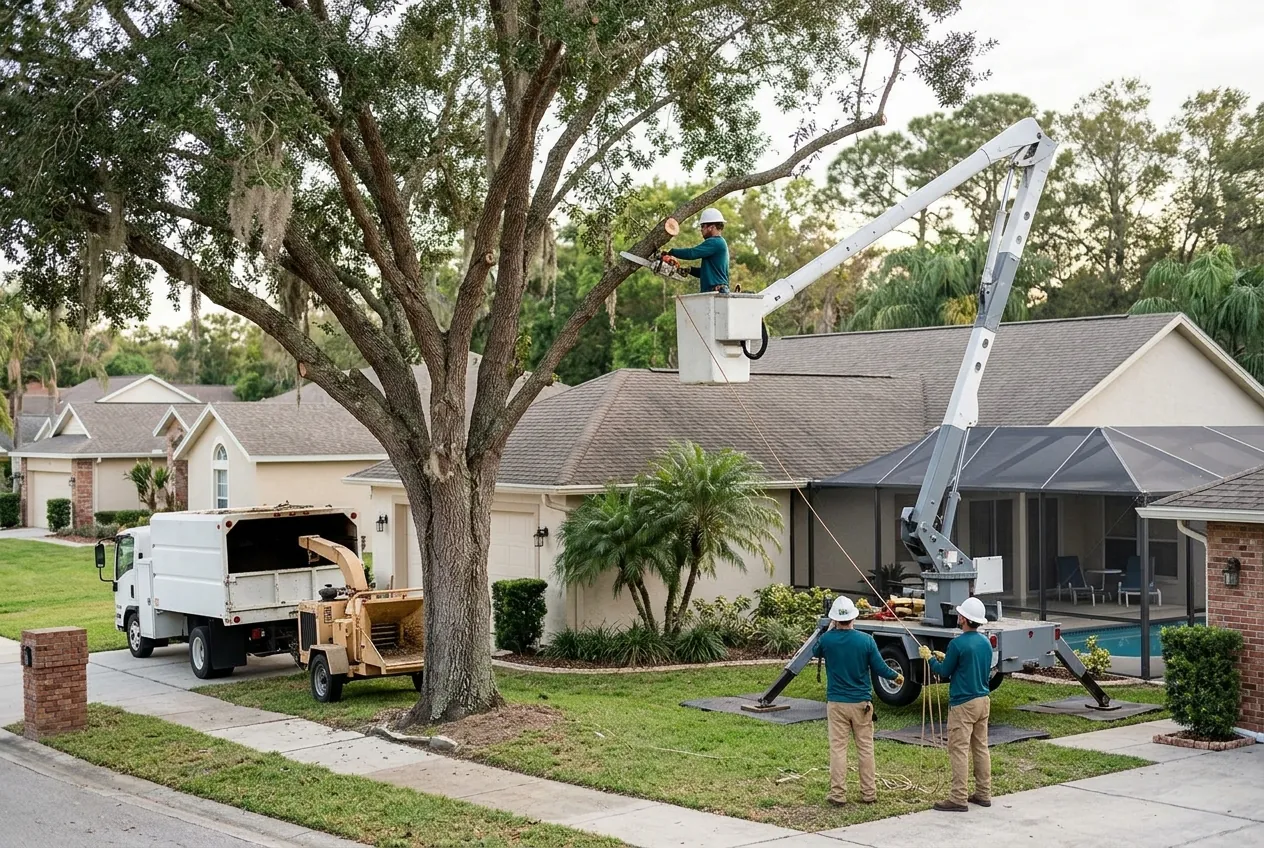
Over roofs, we shorten limbs to a lateral branch rather than cutting them flat at the eaves. Over pool cages and detached garages, the cut pieces come down on ropes. On the century-old parkway oaks in Harbor Oaks, the work is usually spread across visits, because there is only so much a big old oak can lose in one year without paying for it later.
Waterfront oaks get one more consideration. UF rates live oak highly tolerant of salt in the air and only moderately tolerant of salt in the soil, so a bayfront live oak that browned on its windward side after a dry, breezy spell usually needs patience, not a saw. In Del Oro Groves, where the neighborhood's own history says oaks and palms took over the old grapefruit groves and many parcels combine several original lots, the big trees face Old Tampa Bay wind. There we favor shortening the longest east-facing limbs over thinning the whole crown, because that is where the leverage is.
Oak Trimming Season and Two Myths Worth Dropping
You may have been told not to prune oaks in spring because of oak wilt. That advice comes from up north. UF/IFAS states oak wilt is not known to occur in Florida, so there is no oak wilt season to avoid here. The timing that matters locally is the hurricane calendar: get the work done ahead of June 1, and leave the saw in the truck once the hurricane center has named a storm, as Clearwater's own guidance asks. Dead, broken or hanging limbs can come off whenever they appear.
The second myth is that Spanish moss or ball moss is killing the tree. According to UF, neither one damages its host; both are cosmetic, and both grow back after you pull them. We will remove moss if you want the look, but we will not sell it as a health treatment. A thin canopy usually has a different cause, often root damage, soil change or old pruning wounds.
Oak Tree Trimming Cost in Clearwater
Use these 2026 Clearwater-area bands for budgeting only. Every oak is priced in writing after a free visit, and the figure includes hauling each limb away.
| Job | Typical range | What moves the price |
|---|---|---|
| Oak trimming, medium or laurel oak | $400–$850 per tree | deadwood, clearance cuts, debris |
| Oak trimming, large live oak canopy | $850–$1,800 per tree | spread, bucket vs climber, structural cuts |
| Crown thinning / hurricane pruning | $350–$1,300 per tree | tree size, deadwood, how much canopy (legal caps apply) |
| Tree trimming, 60 ft+ or over a structure | $1,100–$2,000 per tree | bucket reach or crane, crew size, haul-off |
Big oaks over a house sometimes need rigging from a bucket truck, and occasionally crane work when the job needs one. Storm-damaged oaks follow a different plan: hazards and broken stubs first, then restoration pruning that UF says takes two to five years. That work is covered under storm damage cleanup, and if an oak cannot be saved, the job moves to tree removal. Before storm season, oaks are usually part of a broader hurricane pruning visit.
Oak work is the heart of our tree trimming in Clearwater. Ask for a free look and we will tell you which oak you have and what it needs.
Oak Tree Trimming Clearwater Questions
Inside City of Clearwater limits, no more than 30% of a protected tree's foliage may be removed in a year. Dunedin and Safety Harbor cap it at 25%, and Dunedin's Grand oaks need a permit even to prune. On big, older oaks we often take less than the cap and spread the work across visits.
No. The spring warning is about oak wilt, and UF/IFAS states oak wilt is not known to occur in Florida. Locally the calendar that matters is hurricane season: finish before June 1, and hold off once a storm has a name.
It depends on its condition. Laurel oaks typically live 50 to 70 years in landscapes and often go hollow with age, so an older one over the house deserves a close look. If the trunk and main limbs are sound, regular light trimming can keep it; if decay is advanced, removal is usually the better spend.
No. UF's guidance is that neither moss damages the tree. Removing it is cosmetic and it grows back, so we only pull it if you want the look.
In 2026 a medium or laurel oak typically runs $400–$850; big live oak canopies land between $850 and $1,800, and crown thinning between $350 and $1,300. Cleanup and haul-off are included, and every oak gets a free written price.
Ordinary trimming no, but removing more than 25% of the canopy, topping or excessive pruning does, and Grand Trees, which include live and laurel oaks 36 inches across and larger that meet the city's scoring, need a permit for any pruning. We measure and check before quoting.
More Clearwater Tree Services
Booked on the same visit.
Trimming
- Tree TrimmingRoof, pool-cage and driveway clearance, deadwood and crown thinning.
- Palm Tree TrimmingDead fronds, pods and fruit stalks off; green fronds stay.
- Hurricane PruningPre-season crown cleaning and thinning, booked before June.
- Tree Trimming Near Power LinesService-drop clearance, scheduled around a Duke disconnect.
Removal
Give Your Oak a Plan
Tree getting too close to the roof? Let’s look at it.
Structure first, clearance second, nothing topped.
Mon–Sat 7am–6pm · storm calls taken